


FY27 Budget Maps Out Plans for Federal IT Modernization
White House proposal outlines funding for AI, drones and missile defense alongside border tech upgrades.

The White House recently unveiled its proposed FY27 budget, revealing its tech priorities for national defense, border security and federal civilian IT.
“President Trump promised to reinvest in America’s national security infrastructure, to make sure our nation is safe in a dangerous world,” OMB Chief Russell Vought wrote in the budget’s introduction. “The 2027 Budget upholds this promise and would ensure that the United States continues to maintain the world’s most powerful and capable military.”
Defense Tech and AI Investments
The proposal calls for significant funding for the Golden Dome missile defense project. According to the Rebuilding Our Military Fact Sheet, the funding supports “development of game-changing space-based missile defense sensors and interceptors, kinetic and non-kinetic missile defeat and defense capabilities, and enabling technologies for a layered, next-generation homeland missile defense system.”
The War Department’s FY2027 request includes a substantial funding increase for autonomous and unmanned systems across the services, supported by one of the largest research, development, test and evaluation (RDT&E) budgets in recent years. The Pentagon’s RDT&E request totals $210.4 billion for FY2027, up from $144.9 billion in FY2026.
“This funding would arm America’s military’s combat units with drones while also providing protection against the proliferation of inexpensive and proliferated unmanned systems by near-peer competitors, rogue states and non-state actors,” DOW wrote in a budget request document earlier this month. “This funding would enable innovative contracting approaches that provide flexibility in rapidly maturing technology and delivering a portfolio of capabilities that broaden opportunities for new entrants.”
The increase — nearly 45% year over year — provides a foundation for AI across War Department mission areas.
“The United States would sustain and maintain its dominance in AI, which is transforming how the department fights and operates. Consistent with America’s AI Action Plan, the budget makes historic investments to aggressively scale its AI ecosystem and ensure broad adoption throughout the armed forces This funding includes the development and fielding of new AI capabilities, buildout of new American AI infrastructure, and continued support for the GenAI.mil platform,” DOW writes.
DHS and Border Security Technology
The budget emphasizes border technology as a central component of the White House’s immigration enforcement strategy within its $63 billion request for the Department of Homeland Security. The plan includes $136 million for the Automated Commercial Environment, the system used by Customs and Border Protection (CBP) to process tariff payments and manage trade data, according to the budget document.
The proposal also calls for expanded aerial surveillance through Coast Guard and CBP assets. Budget documents outline $2.1 billion for U.S. Coast Guard operations to support its Force Design 2028 initiative and a $24.6 billion investment in assets and infrastructure, including workforce expansion to support new vessels and aircraft. The plan also includes $243 million for CBP Air and Marine Operations.
The administration positions technology as a primary enforcement tool along the southern border. The Stopping the Invasion and Violent Crime Fact Sheet highlights new investments in surveillance and detection. The budget document also includes “$322 million for counter-drug technology and laboratory equipment” to combat the flow of illicit substances.
Reconciliation, according to the plan, will provide money for DHS to “finish construction of the border wall on the Southwest border” and “procure advanced border security technology,” though the plan does not specify specific technology initiatives.
Tech Investment Priorities
While defense spending accounts for the largest portion of the president’s budget proposal, the administration is returning federal civilian IT spending to pre-Trump levels. Not including the War Department, Trump is proposing spending $75.7 billion on federal civilian IT, up from $67.9 billion in fiscal 2026 and $75.1 billion in fiscal 2025. Here’s a look at how that will break down at each agency:
- Department of Agriculture: $2.6 billion
- Department of Commerce: $3 billion
- Department of Education: $1.2 billion
- Department of Energy: $5.7 billion
- Department of Health and Human Services: $9.4 billion
- Department of Homeland Security: $11.6
- Department of Housing and Urban Development: $700 million
- Department of the Interior: $1.7 billion
- Department of Justice: $4.3 billion
- Department of Labor: $759 million
- Department of State: $3.7 billion
- Department of Transportation: $5.6 billion
- Department of the Treasury: $6.2 billion
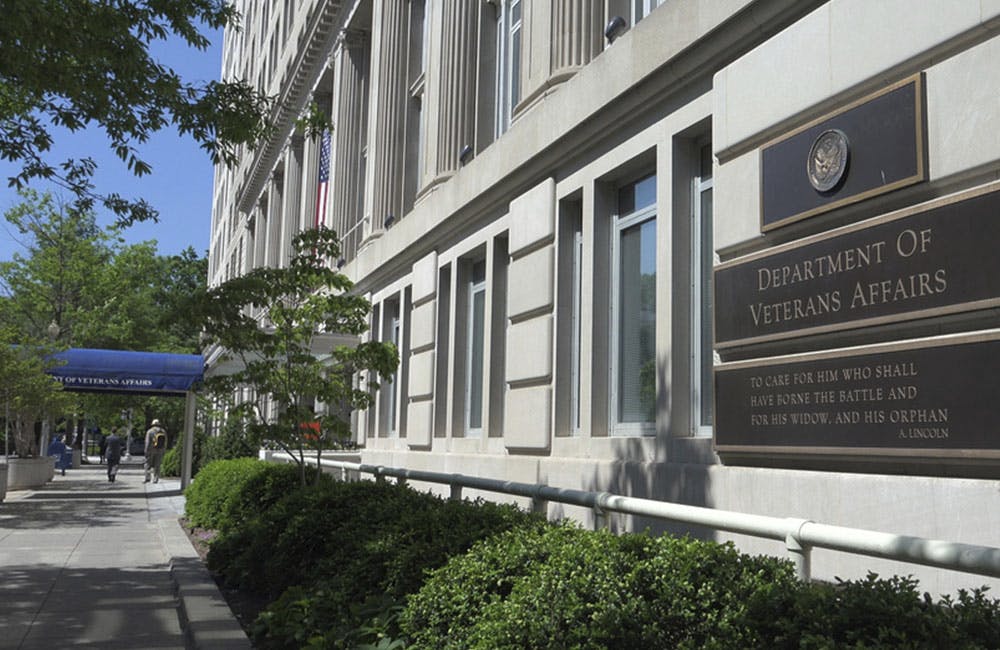
- Department of Veterans Affairs: $12.1 billion
- Environmental Protection Agency: $301 million
- General Services Administration: $1 billion
- National Aeronautics and Space Administration: $1.3 billion
- National Science Foundation: $202 million
- Nuclear Regulatory Commission: $180 million
- Office of Personnel Management: $194 million
- Small Business Administration: $321 million
- Social Security Administration: $2.5 billion
- U.S. Army Corps of Engineers: $221 million
Additionally, the budget proposes spending $12 billion on federal civilian cybersecurity, on par with cybersecurity spending for fiscal year 2026 and 2025. According to OMB’s Analytical Perspectives of the budget, the IT and cybersecurity spending aligns with the administration’s goals of eliminating duplicative and inefficient systems and websites, investing in digital-first services “that are built for real people, not bureaucracy,” funding AI to enhance efficiency and fortifying the government to defend against and combat cyber crime.



This is a carousel with manually rotating slides. Use Next and Previous buttons to navigate or jump to a slide with the slide dots
-

HHS Looks to Centralize IT Buying, Speed Access to Emerging Tech
HHS is centralizing IT procurement while pursuing faster acquisition tools for AI and other emerging technologies.
9m watch -
VA Pharmacy Upgrades Bring New AI Capabilities to EHRs
The agency incorporated feedback from pharmacists in tech upgrades that add AI capabilities and streamline prescription workflows.
3m read -

Pentagon taps Musk to Co-Lead Future Warfare Initiative
War Secretary Pete Hegseth appointed Elon Musk, Newt Gingrich and Palmer Luckey to shape future warfare technology under Project Meridian.
2m read -

Air Force Pushes Open Architectures Across Fighter Fleet
Brig. Gen. Timothy Helfrich said open compute could help the service share software and mission capabilities across its existing fighters.
3m read


