


War CIO Seeks Private Partners to Help Modernize Acquisition
Pentagon’s BOND program recruits industry leaders to help overhaul acquisition, boost supply chains and speed innovation.


The Pentagon is seeking 250 industry executives to join its new private-sector partnership, the Business Operators for National Defense (BOND) program, aimed at strengthening collaboration with the defense industrial base. The department is currently reviewing candidates, CIO Kirsten Davies said Tuesday at the Defense Tech Leadership Summit in West Palm Beach, Florida.
“We’re bringing in industry executives, industry subject matter experts and providing an avenue for industry to come in and be part and parcel of the work we are doing,” she said. “They can then come and be a part of these initiatives of overhauling acquisition and doing acquisition in reform.”
War Secretary Pete Hegseth unveiled BOND Friday, stating the program will bring in industry experts to help DOW overhaul its acquisition process, eliminate “bureaucratic bloat” and “more quickly field weapons to warfighters.” Selected industry leaders will work side by side with teams in Research and Engineering, Acquisition and Sustainment, Personnel and Readiness, the CIO and the Comptroller.
“BOND executives are driving major reforms,” Hegseth said. “Through these collaborations, we are actively accelerating acquisition speed, increasing manufacturing, optimizing production and strengthening supply chain resilience.”
Amazon Web Services announced its own initiative Tuesday: two federal credit programs totaling up to $100 million to accelerate AI innovation and science. The AWS Warfighter Capability Accelerator Initiative and AWS Genesis Accelerator Initiative will each provide up to $50 million in AWS credits over three years to help federal agencies, national laboratories and their supporting organizations rapidly develop and deploy advanced capabilities using AWS cloud services and generative AI technologies.
David Appel, vice president of Global Government, National Security and Defense, told GovCIO Media & Research the credit program is meant to accelerate innovation and reduce friction as organizations move to the cloud. He said companies, especially startups, need to focus on delivering products to solve national problems, rather than focusing on infrastructure costs.
“As a nation, we need to move faster to — for National Security and Defense — to the cloud, to AI, and our adversaries don’t play by the same rules that we play in the U.S.,” he said. “As we think about what’s going on in Europe or the threats in the Pacific, we need to move faster, and these are all meant to help us move at scale.”
Davies, who is an advocate for public-private partnerships and cross-industry collaboration, urged industry leaders to examine their technology debt, as it will have a “direct correlation” to innovation.
“I encourage you all, just as I’m encouraging internal to the Department of War … We must deal with the technology debt that’s here, we must break down the silos of data and application sets and demand and require interoperability, so that the innovation can reach the heights that it is absolutely capable of reaching,” she said.

This is a carousel with manually rotating slides. Use Next and Previous buttons to navigate or jump to a slide with the slide dots
-
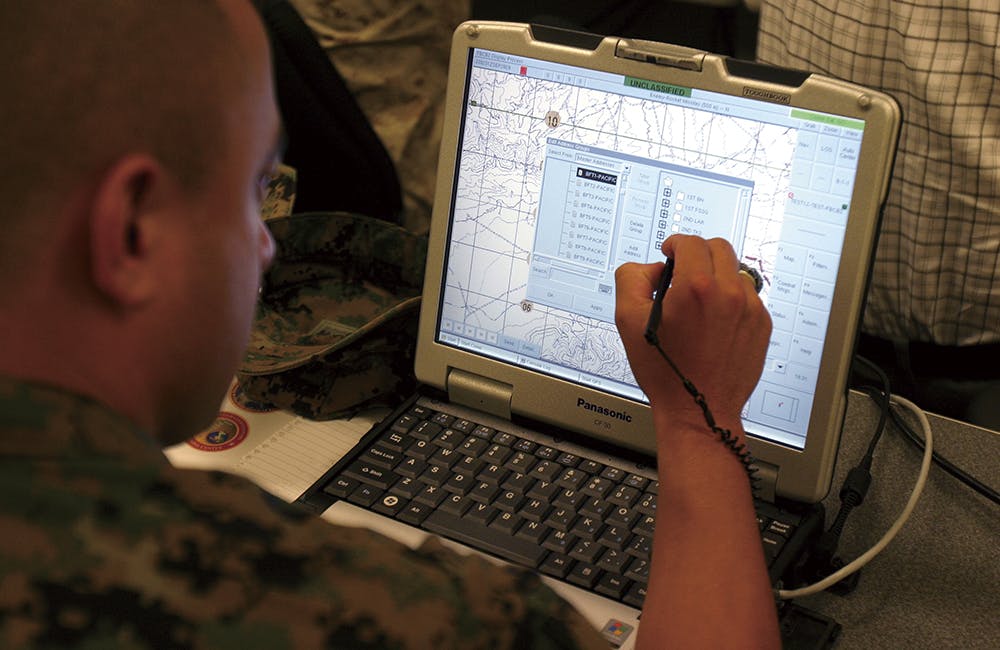
Marine Corps, Coast Guard Lay Groundwork for AI Operations
Service officials are improving data and network infrastructure to support AI-enabled operations and information sharing.
2m read -

AI, Zero Trust Drive Geospatial Intelligence Modernization
NGA CIO Mark Chatelain discusses how zero trust, cloud modernization and AI are strengthening cyber resilience and accelerating geospatial intelligence.
8m watch -

AI Could Transform Cyber Defense, But Security Must Come First
Axonius Federal Field CTO says agencies need greater visibility, measurable cyber readiness and tighter AI token controls to safely accelerate missions.
7m watch Partner Content -

Stratcom Commander: ‘Absolute Dominance’ Cannot Be Assumed
Adm. Richard Correll outlined how AI, autonomy, information warfare and precision weapons are reshaping the strategic threat environment.
4m read


