CIA Adds Fourth Pillar to AI Strategy, CAIO Says
Lakshmi Raman says the new pillar marks a strategic shift toward embedding AI more deeply into the CIA’s day-to-day mission execution.

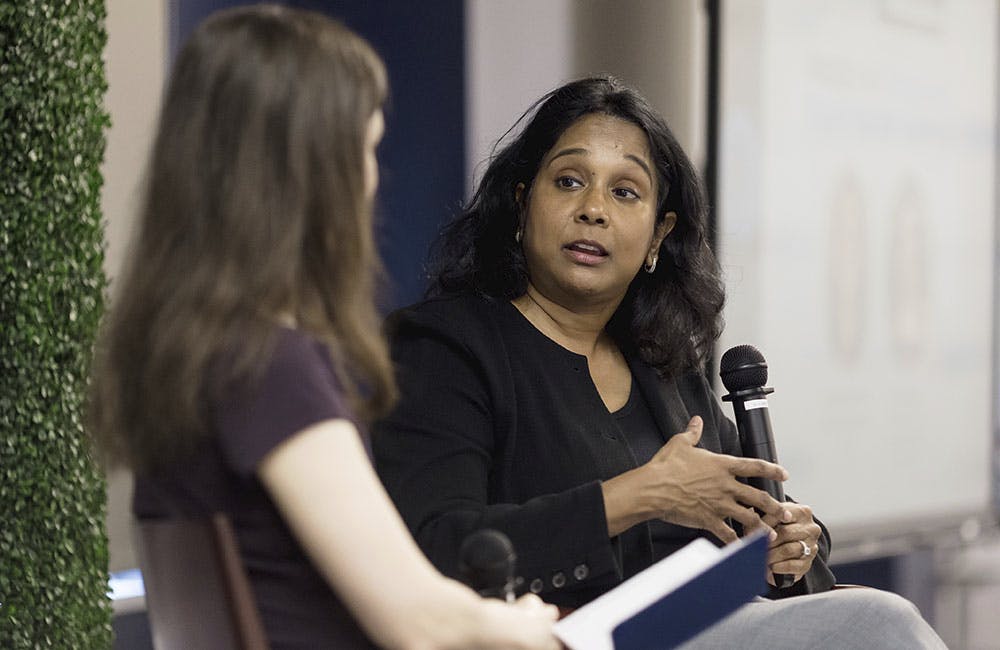
The Central Intelligence Agency has introduced a fourth pillar to its artificial intelligence strategy, aimed at directly supporting the agency’s core missions: objective analysis, intelligence collection, covert action at the president’s behest and counterintelligence, CIA AI Director and Chief AI Officer Lakshmi Raman said Tuesday at GovCIO Media & Research’s AI Building Blocks Workshop in Washington, D.C. on Tuesday.
Expanding CIA’s AI Strategy
The new pillar builds upon the CIA’s existing three-part strategy, which focuses on understanding adversaries’ AI capabilities, improving internal operations through AI and ensuring responsible AI stewardship through rigorous standards, testing and fiscal oversight. Raman said the fourth pillar marks a strategic shift toward embedding AI more deeply into the CIA’s day-to-day mission execution.
“How are we enabling access to AI? How are we democratizing access so that our data scientists or developers are able to access it very easily?” said Raman. “We’re thinking now beyond the step of democratization to commoditization. How are we commoditizing AI, so it’s available all the time so that our officers can integrate it into workflows that they use every day?”
Raman said that the CIA has been involved with AI and data science since the teens, when its first data scientist began working with the technology. CIA’s AI work has evolved with the rapid advancements outside of government, creating opportunities for the agency’s mission and strategy, she added.
“We’ve definitely seen the advancement and the excitement and the evolution of AI,” said Raman. “We’ve been really excited about the opportunities that it brings to [the intelligence community’s] mission and our strategy.”
Building the Future AI Workforce
Securing top AI talent for the agency is both a challenge and an opportunity, Raman said. While there is a robust demand to hire AI engineers, data scientists and machine learning professionals, Raman said that the agency is committed to upskilling its workforce at all levels, from general staff to senior officials.
“We are putting a lot of effort towards educating and training and upskilling our workforce … to understand how to partner and do human-machine teaming,” said Raman. “[CIA staffers] really need to have the latest and greatest understanding of the technology all the way up to our senior leaders.”
Bolstering Industry and Government Collaboration
Raman stressed the importance of robust partnerships with private industry, where AI innovation is most robust.
“We need to be able to have those private industry partnerships … and then be ready to bring them into the agency, bring them into the IC as quickly as possible,” said Raman.
The CIA’s proactive stance on AI positions it as a leader across the broader government landscape, Raman said. She said the agency’s leading position is from an enduring commitment to addressing emerging challenges and collaborating with other officials, including regular discussions with intelligence community CAIOs.
“The fact that we are leaders in the IC – and I would say in the government writ large – with respect to our approach to AI, in some ways, is not much of a surprise to me at all,” Raman said. “I’m incredibly proud of the organization.”
The Evolving Role of CAIO
The CAIO role is as strategic and collaborative as it is technical, Raman said. Citing technology industry leaders like Google’s Eric Schmidt and Microsoft Satya Nadella, who view AI as a key driver of national power and a “defining technology,” Raman highlighted the CAIO role’s importance in aligning strategic priorities with this transformative technology. Without such leadership, she said, AI adoption could be fragmented, less compliant and lead to duplication of effort and inefficiency in government and industry.
“AI is moving so quickly,” Raman said. “We need to be ready within the government and the intelligence community to quickly take the new technologies that are coming as quickly as possible and determine how they apply properly to our mission.”
This is a carousel with manually rotating slides. Use Next and Previous buttons to navigate or jump to a slide with the slide dots
-

Navy Pushes AI from Experiments to Everyday Warfighting Functions
The Navy’s hybrid fleet hinges on a common naval lexicon and trustworthy AI woven into every intelligence function.
6m watch -

VA Launches Tech Pilot Portfolio to Accelerate Modernization
The Department of Veterans Affairs launched technology pilots to accelerate modernization by testing tools that enhance veterans services.
5m read -

Navy’s Future Fleet Hinges on Autonomy, Agility
Navy officials detail how AI, unmanned systems and agile acquisition will drive the next generation of maritime operations.
5m read -

Federal AI Series: Security Priorities
AI security threats, data protection and emerging defenses power federal agency tech strategies as AI adoption accelerates.
7m watch Partner Content