


DHS AI Board Sees Civil Rights as ‘Part and Parcel’ of AI Safety
Secretary Alejandro Mayorkas shared details about the new board’s first meeting and how he sees it transforming the agency’s AI development.
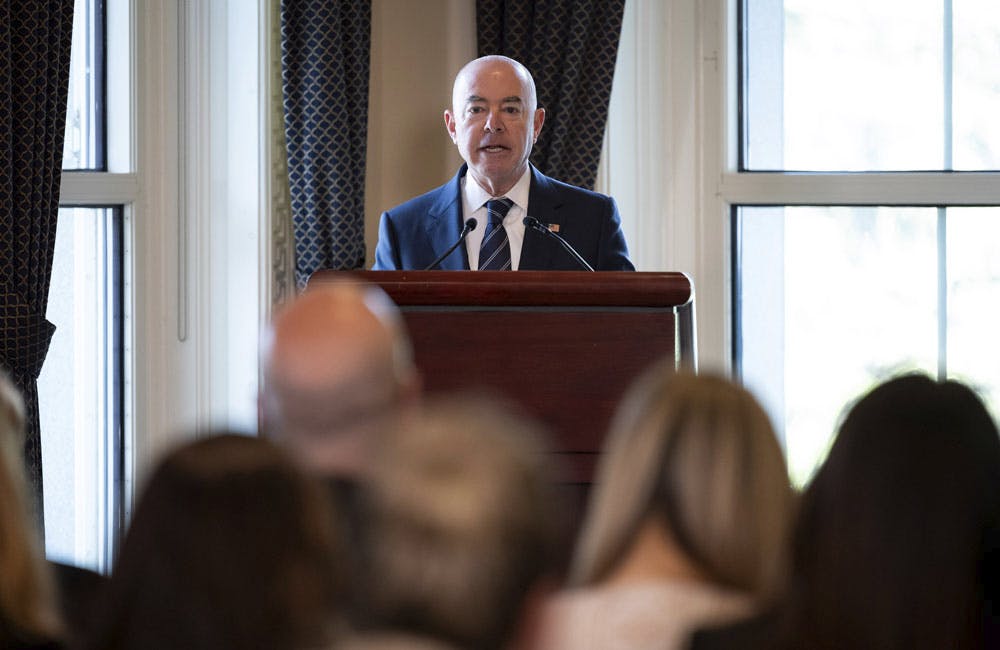
SAN FRANCISCO – The Department of Homeland Security’s new Artificial Intelligence Safety and Security Board held its first meeting this week and recognizes that safety and civil liberties depend on one another, said DHS Secretary Alejandro Mayorkas.
“What we heard yesterday was an articulation of the fact that the civil liberties, civil rights implications of AI really are part and parcel of safety,” Mayorkas said at RSA Conference Tuesday in San Francisco. “What distinguishes this board, in addition to the fact that it’s focused on critical infrastructure, is that it is focused on practical application of AI and the propagation of guidelines that have real- life implications.”
The agency launched the board last week with an aim to advise the government on AI’s role in protecting and securing critical infrastructure. Board members include Brookings Center for Technology Innovation Director Nicol Turner Lee, OpenAI CEO Sam Altman, IBM CEO Arvind Krishna and Humane Intelligence CEO Rumman Chowdhury.
In addition to the board’s responsibilities, Mayorkas laid out his vision for responsible AI development and use at his agency.
“What I would love is for this audience to take a look at DHS in five years and say, ‘Wow, I cannot believe how they are using AI to advance their mission,’” he said. “That is redefining a perception of government, not as slothful and labyrinthian, but nimble, dynamic and really pushing the envelope ourselves.”
Following the first board meeting, Mayorkas said the group will be working with international partners to further global cybersecurity cooperation.
“[The board works] very closely with our international partners. Five Eyes, most especially, but the breadth of our international work is fancier than that,” he said. “I actually think coming out of the board meeting yesterday that this board can play a very, very significant role given us membership in driving harmonization.”
Mayorkas said the board is open to ideas that will make AI safer and more representative of American values.
“We perpetuate this in all aspects of our work and our goals include the advancement of our values — it is not achieving a particular outcome,” he said.

This is a carousel with manually rotating slides. Use Next and Previous buttons to navigate or jump to a slide with the slide dots
-
Federal PQC Migration: 3 Resources to Help Agencies Prepare
NIST, CISA and NSA provide tools and guidance to help federal agencies meet upcoming post-quantum cryptography migration deadlines.
3m read Partner Content -

Army Extends its Central Data Hub Pilot Until October 2027
The Army Data Operational Center (ADOC) received a year funding extension to “formalize the structure” before potentially becoming permanent.
-

White House Taps Kirsten Davies as Acting National Cyber Director
After Sean Cairncross' departure, the Pentagon CIO brings experience in cybersecurity, PQC migration and workforce modernization to the role.
3m read -

Recent IT Outages Highlight Need for Better Coordination, Clear Performance Metrics
Recent federal IT outages are raising questions about coordination, system reliability and how agencies measure technology performance.
5m read


