DOE National Labs Launch New AI Tools for Operational Efficiency
The Energy Department’s National Laboratories are using AI to increase operational efficiency and drive research efforts forward.

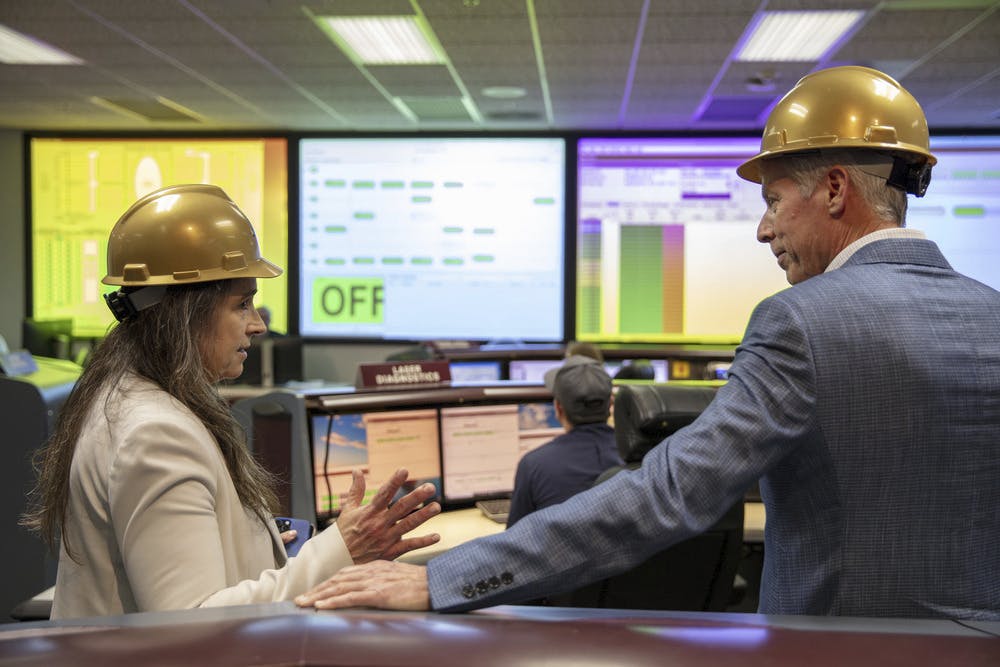
The Energy Department’s National Labs are developing new internal AI tools to boost operational efficiency, leaders explained on Tuesday during the AWS Summit in Washington, D.C.
AI Supports Troubleshooting at Lawrence Livermore National Lab
Lawrence Livermore National Laboratory (LLNL) National Ignition Facility (NIF) partnered with Amazon Web Services (AWS) to develop an AI-driven troubleshooting and reliability system to support its workforce.
“AI is transforming our troubleshooting and maintenance going forward within our operations team, and the collaboration with AWS is pivotal to making this happen,” said NIF Laser Systems Engineering and Operations Lead Shannon Ayers during the panel.
The new troubleshooting tool searches through over 22 years of experiment data to create a decision tree for LLNL NIF researchers, Ayers told GovCIO Media & Research in an interview. The tool streamlines the database’s search function, saving time and increase operational efficiency as researchers reference previous problem logs.
“Data is our product. The more data we produce, the quicker we’re going to solve the problems that are really important to our national security and advancing fusion energy,” Ayers added. “Efficiency is a multi-layered, but [it’s] core to how we conduct our business.”
The partnership comes at a time when DOE Secretary Chris Wright has called for an increase in nuclear energy and AI to support the U.S. energy grid. LLNL NIF said in a press release successful implementation of the AI tool will establish a new standard for AI applications and may influence operational approaches at other national laboratories.
Idaho National Lab Launches AI Virtual Assistant
DOE’s Idaho National Laboratory (INL) launched a new internal AI virtual assistant called AiVA, Director of Scientific Computing and AI and Director of the Digital Innovation Center of Excellence at Idaho National Laboratory (INL) Chris Ritter told GovCIO Media & Research in an interview. He added that, while his team did not promote AiVA, they experienced a large amount of organic interest in the AI tool.
“People just organically know that this technology can help them with their job,” Ritter told GovCIO Media & Research. “We’re always deploying more industry models and making them available to our staff at the laboratory.”
Ritter said AI adoption has grown at INL as teams shift their mindset about the tech. INL has worked to inform employees about how and why AI tools are being used through public-private partnerships.
During one of the national lab’s AI Jams, partners like AWS demoed the latest AI models. Ritter said this helped accelerate INL’s interest in AI applications, and researchers began asking for newer AI models to use.
“[Our employees] are pushing us to get the latest AI, and [AWS] is also pushing us to go faster,” said Ritter during his panel. “We’re all pushing each other, and I think that’s a huge part of why we’re moving rapidly now.”
He added, “If we can use AI to accelerate [our] missions, you’re talking about very world changing technology that everyone can benefit from.”
This is a carousel with manually rotating slides. Use Next and Previous buttons to navigate or jump to a slide with the slide dots
-

Accelerating Federal Cloud Modernization
IT officials from CMS, DOE and NinjaOne discuss data readiness, security and change management for cloud modernization.
20m watch -

Navy Pushes AI from Experiments to Everyday Warfighting Functions
The Navy’s hybrid fleet hinges on a common naval lexicon and trustworthy AI woven into every intelligence function.
6m watch -

VA Launches Tech Pilot Portfolio to Accelerate Modernization
The Department of Veterans Affairs launched technology pilots to accelerate modernization by testing tools that enhance veterans services.
5m read -

Navy’s Future Fleet Hinges on Autonomy, Agility
Navy officials detail how AI, unmanned systems and agile acquisition will drive the next generation of maritime operations.
5m read