


Edge Computing Critical To JADC2 Success
The joint force needs transformational computing technologies to achieve JADC2.

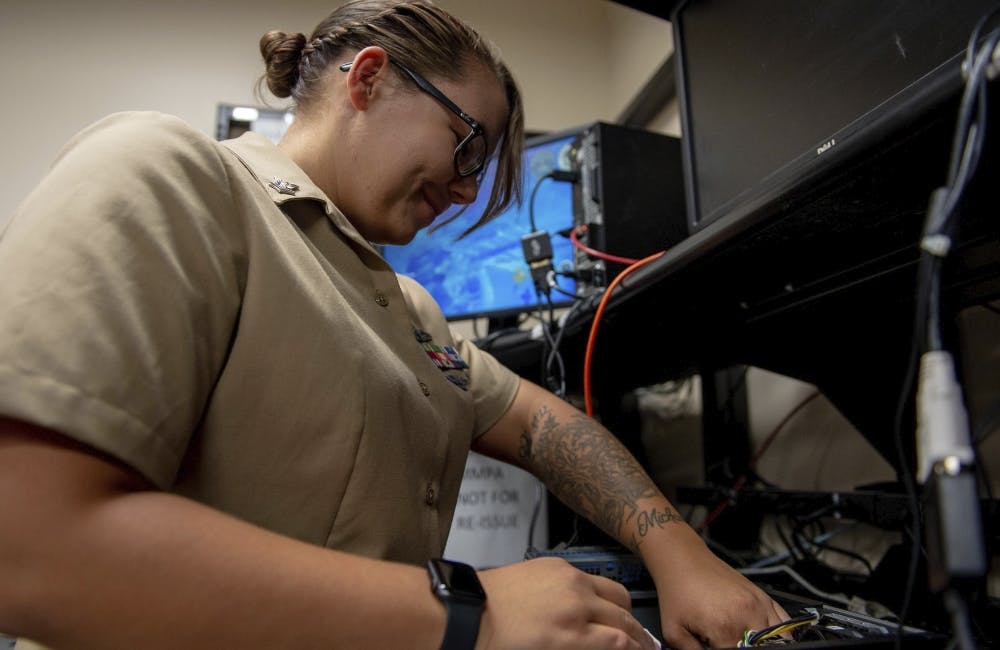
Edge computing will play a critical role in the Defense Department’s efforts to implement the Joint All-Domain Command-and-Control (JADC2) concept to put actionable data in the hands of the warfighter, according to a Naval Information Warfare Center senior software engineer speaking at a MeriTalk event this week.
Various military platforms depend on sensors collecting enormous amounts of data to support multi-domain missions. Edge computing capabilities enable processing sensor data in real-time, analyzing and producing insights at mission-speed and interacting with captured data at various connectivity levels.
As the Department of the Navy’s edge computing architecture evolves, breaking down physical silos is a key area of concern.
“One of our challenges, specifically in the Navy … is almost every technology that comes to me, a piece of software tends to be delivered on a physical device,” Richard Jack, senior software engineer at NIWC PACIFIC, said at the MeriTalk Insights at the Edge panel. “So, how do I take it off the laptop? And so what we’re trying to do is democratize this capability in such a way that allows people to deliver us capability without delivering us the physical constraints that the software is being delivered upon.”
Successful edge computing, he added, keeps user experience top of mind.
“When I talked to the services, I think I tried to emphasize that we prioritize and emphasize understanding who our operators are. That is the most important concept to really get our heads around when we start talking about edge computing,” Jack said. “There’s a human capital behind this that I really like to think about. So that’s what I would advocate to all of our partners here as we go through these things.”
The way the capabilities are delivered needs to be simplified, he said, and the skill sets need to be more adaptable for warfighters to execute their mission.
“If we’re going to do that, we’re going to have to make it simpler,” Jack said. “If we’re going to provide capabilities to warfighters, that needs to be able to be operated by our sailors, marines, soldiers, and airmen that are actually going to use these capabilities.”
Machine learning (ML) and automation can also improve edge computing processing times.
“Machine learning is at our doorsteps. We’re starting to play around relative to how we’re actually going to enable mission effect with machine learning,” Rick said. “With that comes the burden of ‘how do we keep cadence with the accelerated pattern of the way we’re getting after this? You know, machine learning comes with a constant cadence of … being adaptable.”
Because of the distributed nature of DOD, data is always on the move, which puts the data at greater cybersecurity risk. To keep edge data secure, zero trust will be crucial to addressing the threat landscape and handling interconnected devices.
“If we think about tactical edge computing, the key cyber effects that we care about is really embracing those protections that are in place – proper encryption, excellent controls that we have in place,” Jack said. “Zero trust is going to be the key element … that’s going to help us really solve a lot of these problems. That is a journey by the way … It takes a while, it’s an important part of this.”

This is a carousel with manually rotating slides. Use Next and Previous buttons to navigate or jump to a slide with the slide dots
-

Modernizing Army IT for AI
Army CIO Gabe Chiulli and CDO David Markowitz explain how Army technology modernization is powering AI at the tactical edge. Sponsored by Knox.
44m watch Partner Content -

Building Resilient Teams: Culture Eats Strategy for Breakfast
Jamie Holcombe shares how trust, mission clarity and employee well-being help leaders build resilient teams and sustain innovation.
24m watch -

IC Agencies ‘Operate in the Gray’ to Accelerate Acquisition
Intelligence agencies are increasingly moving from traditional contracting models to a more outcome-based mindset.
5m read -

Federal Tech Leaders Summit
The Federal Tech Leaders Summit 2027 brings together federal CIOs and CTOs at this government CIO conference on IT modernization, cybersecurity and AI.
Washington, D.C.


