


Federal CIOs Push for ROI-Focused Modernization to Advance Mission Goals
CIOs focus on return on investment, data governance and application modernization to drive mission outcomes as agencies adopt new tech tools.
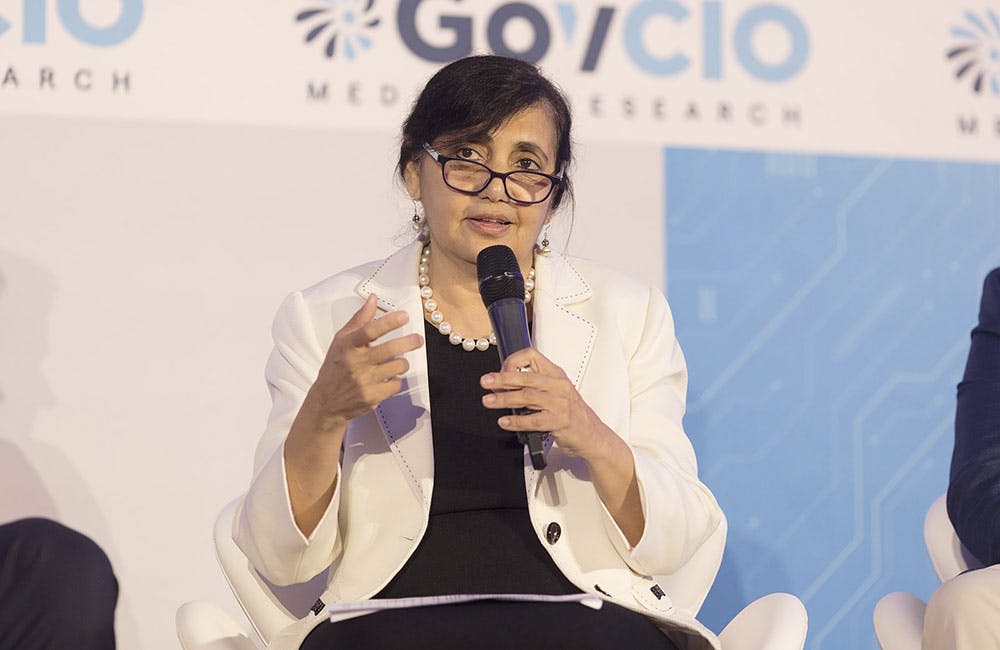
Agencies need to focus on return on investment and mission enablement to effectively modernize legacy systems toward agile, digital environments, officials said during GovCIO Media & Research’s Federal IT Efficiency Summit in Tysons Corner, Virginia on Thursday. IT leaders are honing in on data and application modernization along with partnerships to realize the benefits of innovation’s potential.
“[We are] ruthlessly prioritizing value, because technology is very pizzazzy these days,” said USPS CIO Pritha Mehra. “We’re really trying to figure out where to spend the effort for the return on investments … There are some technologies now that are going to catapult our experiences.”
Data as the Foundation of Modernization
Data governance is not merely a technical undertaking but a fundamental prerequisite for effective modernization, officials said. Mehra said that USPS found success in breaking down deeply-entrenched data silos.
“With an organization as large as ours, we have data sets that everybody [individually] owns. ‘Don’t touch my data, it’s mine,’ and, then finance says ‘that’s mine,’” said Mehra. “We had to break down a lot of the data silos, and once we established a Chief Data and Analytics office [tasked with] enterprising our data, not only are we enterprising it, but we’re also making sure that it’s tagged correctly, that we have the right metadata.”
Cybersecurity and Infrastructure Security Agency (CISA) CIO Robert Costello said that agencies need to understand data’s value to the mission, its retention and its diverse stakeholders. He highlighted CISA’s focus on “fusion of cyber infrastructure and risk data to break down those silos.” Breaking down these barriers, he noted, is crucial for informed analysis and mission success.
“We have a ton of data … It’s a lot,” Costello said, “One of the things that that I think has to be understood is the value of the data to the mission and how long we keep the data, which is absolutely critical when we start talking about anything that could have PII or other [valuable] information in it.”
Costello added that CIOs need to understand a holistic view of an organization’s mission and each level’s job to modernize IT systems efficiently and effectively.
“How do we enable and understand the mission better in my office, to deliver better solutions, to improve mission outcomes?” said Costello. “We’re probably very embedded with our mission operators. That means sometimes I have to spend a day with the CFO, not to try and get money … but to understand her mission.”
National Cancer Institute CIO Jeff Shilling said that his agency’s research data requires data readiness for AI and emerging technology. The change in research findings, he said, requires data to be updated faster for the systems in place, making data certification crucial for researchers.
“I think that we’re really going to look towards certification of data sets, more formalized structure around what is believed to be today [against last year] and have a cadence where so the AI learns,” Shilling said. “I think that will be important, both historical for research and for all practitioners in the cancer space.”
Modernizing Applications for Enhanced Capabilities
Agencies need to also modernize application strategies for efficiency, officials said. CEO Ryan Lewis of Rancher Government Solutions noted that the increasing demand for data access directly fuels application modernization in the public sector. He explained how modern microservices infrastructure provides agencies the flexibility to make dynamic changes and grant specific access, which is “untenable” in legacy formats.
There isn’t a day that goes by right where there isn’t some new functionality or capability building out as a reg pipeline,” Lewis said, “In order to do that, then you have to be able to have a modern microservices infrastructure running underneath.
Lewis added that he sees a future where organizations can dynamically provision their own infrastructures and application systems, irrespective of on-premise, cloud, or multi-cloud environments, signifying a departure from the “rush to get fully virtualized into a singular cloud environment” of the past.
Mehra added USPS moved from monolithic legacy systems to modular, API-first architectures and microservices. This enabled a targeted approach, she said, modernizing high-value applications to satisfy customers.
“In yesteryear, when we did something, if it worked? It would be fabulous,” Mehra said of USPS customer-facing applications. “Now, it has to have under 100 millisecond latency and it has to be 24/7 on. I was like, ‘who’s buying products at 2:00 a.m.?’ Never mind, there’s always someone buying products in the middle of the night. The barometers are just so different right now.”
Cultivating a Culture of Collaboration and Change
Collaboration is critical to mission success, Costello added. CISA works with organizations in and out of government, he added, and translating across them is important for the agency. Costello added that his agency serves as a “partnerships organization” for state, local, territorial and tribal governments, as well as critical infrastructure, underscored the necessity of bringing diverse systems together.
“The federal civilian executive branch agencies depend on us. We work with critical infrastructure, both the private side of that as well as maybe that municipality that’s running a water treatment plant,” said Costello. “It’s really important that we can stitch things together to see if something is happening. That’s what I’m really concentrating on right now: the fusion of cyber infrastructure and risk data to break down those silos.”
Mehra said that USPS expanded the architecture group significantly to drive the adoption of modern capabilities.
“We actually restructured our CIO group and expanded our architecture group,” Mehra said. “It was eight people. It’s now 50 and they are the champions of change. They are the ‘messiahs’ that take in and anything that is being modernized, ensuring that we are using modern capabilities.”
Shilling said the complexity of modernization often lies in people, and the workforce needs adequate training and confidence as workflows fundamentally change. NCI’s focus on evolution through data aggregation and formalized standards helps different research groups achieve consistent analysis results, he said.
Lewis highlighted that modernization efforts must consider new “vectors” like edge devices – from smart devices at airports to equipment in mail distribution plants – ensuring they are tied back to the broader enterprise. The goal, he stated, is to achieve a “single pane of glass” view across all resources, breaking away from siloed modernization efforts that hinder comprehensive visibility and management.
Costello said that the CIO’s role is the “glue” that enables operators, ensuring technology helps them achieve mission. CIOs need to prioritize value, embrace emerging technologies and foster continuous iteration and learning. He also cautioned against speed for the sake of speed against working with industry to modernize effectively.
“We need to be careful, as CIOs, to not get over our skis when we’re trying to roll out things that don’t actually help people,” said Costello. “[A solution] won’t always be that flashy AI thing that you come in and show us. It might be, it might not be. What I’m really excited for is a better relationship with industry to drive solutions.”
“No one will say, wow, you know, ‘Bob, you did a really great job. You saved $50 million but the mission failed,’” Costello added. “That’s not what we’re about.”

This is a carousel with manually rotating slides. Use Next and Previous buttons to navigate or jump to a slide with the slide dots
-

Federal Call Centers Embrace AI
Federal leaders are using AI and other technologies to manage growing call volumes, prioritize requests and improve the caller experience.
23m watch Partner Content -

Preparing for PQC Migration at Federal Agencies
NIST, DOW and industry leaders discuss how agencies can prepare systems, prioritize risks and scale the transition to post-quantum cryptography.
27m watch Partner Content -

How CDM Is Evolving to Counter Emerging Cyber Threats
CISA’s Acting Associate Director for Capacity Building and CDM Program Director discusses how the program is now tackling threat mitigation.
31m watch -

Edge AI Brings Faster Decision-Making to Federal Missions
Edge AI can help process data faster in dispersed environments such as battlefield medicine, satellites and wildfires.
4m read


