


JAIC, GSA Collaboration Driving AI Solutions Into Acquisition Processes
DOD’s AI center is helping GSA implement AI across government.
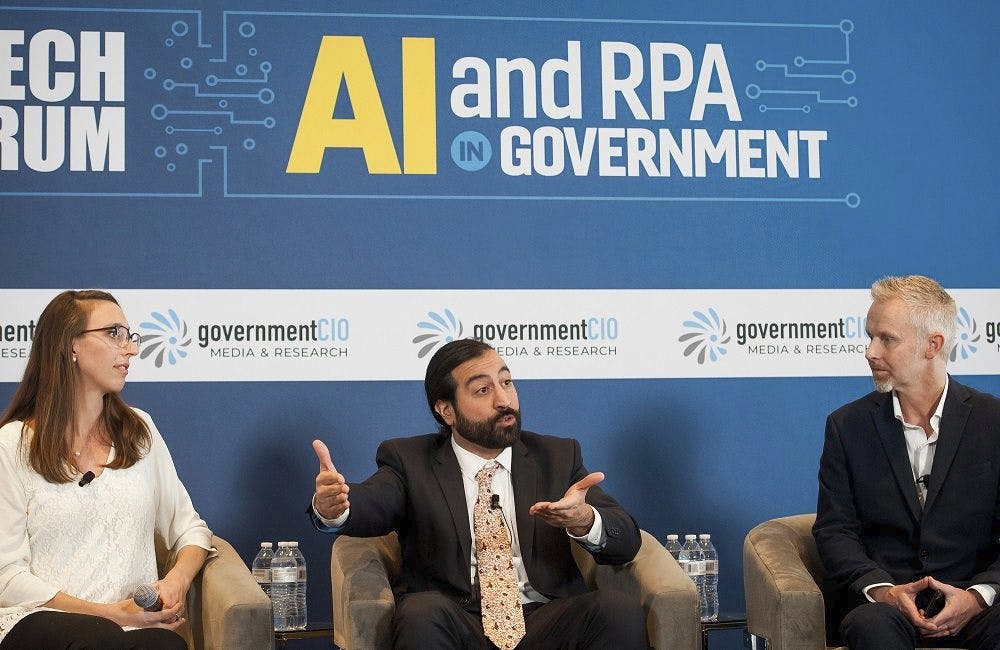
General Services Administration acquisition leads hinted how the agency’s collaboration with the Defense Department’s Joint Artificial Intelligence Center is not only scaling up procurement practices with AI, but informing how civilian agencies can learn from the partnership with their own AI-driven acquisition processes.
GSA Centers of Excellence Acquisition Leads Omid Ghaffari-Tabrizi and Michelle McNellis spoke about the GSA-JAIC partnership GovernmentCIO Media & Research’s AI and RPA CXO Tech Forum, where they explained how implementing agile, internal processes innovations and other practices are driving that cooperation.
The partnership with JAIC is currently in its beginning stages, which include internal strategizing, McNellis said. The partnership involves two contracting shops — a main one that focuses on procuring technologies for DOD and a counterpart in GSA, added Ghaffari-Tabrizi. The setup, he said, has helped GSA’s Centers of Excellence grow AI capabilities and acquisition.
“We’re trying to take a lot of what we’re doing with JAIC — with the national mission initiatives that they work with, and all of the AI that we’re procuring for them — and we’re also hoping to procure for ourselves and make sure [we] implement a lot of these technologies within our own processes,” Ghaffari-Tabrizi said.
GSA and its Centers of Excellence often focus on satisfying the mission of its project teams, so the centers themselves do not get the opportunity to look at what they need to procure to support the centers’ own team members, Ghaffari-Tabrizi added. With the partnership, however, GSA can move toward adopting its own AI-driven tools, such as a chatbot that can answer various acquisition-related questions.
“One of the things I’m trying to do internally is try to figure out a way that I could get a knowledge repository of frequently asked questions that we get internally, just about procurements in general,” McNellis said. “I’m not a technical person. I’m an acquisitions person, so I need to rely on my technical team to figure out a way — once I get these types of questions — how do I make it so that we can maybe make a chatbot or something along those lines?”
One of the most painstaking processes in acquisition is in lead time, so she said that automating the processes between the different steps would be another way she could envision speeding up the procurement of innovative technologies in both defense and civilian agencies, McNellis said. With the pace of technological change, she said this would keep agencies modernized and technologically up-to-speed.
Baking automated solutions into the acquisition process could also help industry partners out, McNellis and Ghaffari-Tabrizi said. McNellis said that the Centers of Excellence have a request for information up at all times to encourage constant engagement with industry rather than have stovepiped RFIs and pre-solicitation processes. Ghaffari-Tabrizi said that if the centers could implement AI to help process questions and answers to the RFI, solicitations can better incorporate feedback.
“We want that rapid-fire feedback loop to be open as long as we can have it open, have it as responsive and dynamic as possible,” Ghaffari-Tabrizi said, “because everything we can learn during that period is what we’ll bake into the solicitations we’ll end up putting out.”
While the two acquisition leads expressed enthusiasm about the possibilities that will come from their new partnership with JAIC, they added that increased perspectives into their work overall will only drive automation into acquisition in better ways. Working with DOD has enabled more acquisition and technical experts, as well as end-user feedback, but McNellis and Ghaffari-Tabrizi said they are also open to academic and industry input.


This is a carousel with manually rotating slides. Use Next and Previous buttons to navigate or jump to a slide with the slide dots
-

Federal PQC Migration: 3 Resources to Help Agencies Prepare
NIST, CISA and NSA provide tools and guidance to help federal agencies meet upcoming post-quantum cryptography migration deadlines.
3m read Partner Content -

Army Extends its Central Data Hub Pilot Until October 2027
The Army Data Operational Center (ADOC) received a year funding extension to “formalize the structure” before potentially becoming permanent.
-

White House Taps Kirsten Davies as Acting National Cyber Director
After Sean Cairncross' departure, the Pentagon CIO brings experience in cybersecurity, PQC migration and workforce modernization to the role.
3m read -

Breaking Down HHS' Five Health IT Final Rules Reshaping Interoperability
The HTI rules address AI transparency, data exchange, patient access and regulatory reform as HHS prepares for a potential sixth rule.
3m read


