


Marine Corps, Coast Guard Lay Groundwork for AI Operations
Service officials are improving data and network infrastructure to support AI-enabled operations and information sharing.

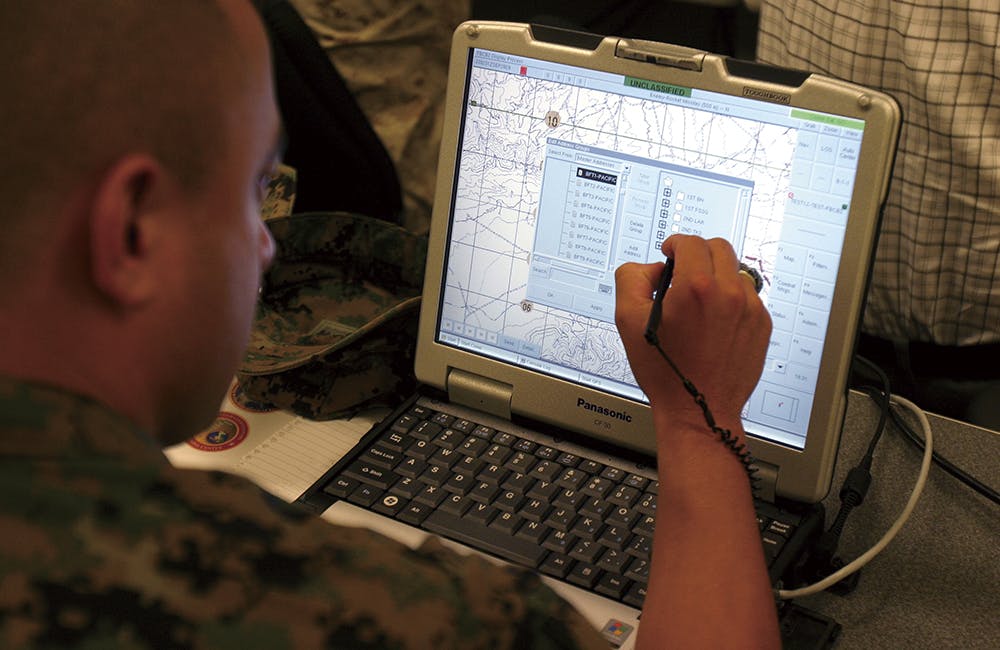
The Marine Corps and Coast Guard are investing in artificial intelligence and machine learning infrastructure to enhance operational capabilities as part of broader War Department efforts to build an AI-enabled force.
Each service is taking a different approach to measuring how these technologies affect warfighting capabilities, including intelligence-to-action timelines and targeting effectiveness, officials said at the DoDIIS Worldwide Conference in Tampa, Florida.
Jeff Hurley, director for information, command, control, communications and computers (IC4) at Marine Corps, expressed concern about how emerging technologies will affect speed and effectiveness.
“What is that transition going to look like?” Hurley said. He added that the Marine Corps’ IT transport strategy is designed with the future in mind, allowing the service to adapt to a variety of technology changes.
His greatest concern is AI. Hurley said the technology is central to discussions at government IT gatherings, where it is often portrayed as either overwhelmingly beneficial or harmful, with little discussion of the middle ground.
“AI is absolutely an important tool, and it is absolutely going to be the future. I don’t need to spend a million dollars on an AI solution to solve a 50-cent problem,” Hurley said.
He advised vendors to understand the differences between machine learning and AI and to bring the services solutions to specific mission problems rather than technology in search of a use case.
Data Requires Diligent Tagging
Cross-domain intelligence sharing can enhance effectiveness in battle, but security architectures can sometimes limit the ability to quickly move information where it is needed. One of the most important considerations is balancing security with availability, said William White, CIO for intelligence at the Coast Guard.
White said human processes can also delay information processing and sharing. AI and standardized data-entry forms could automate some of those processes and accelerate information flows.
“People sometimes overclassify systems, or overclassify email or whatever they’re trying to actually move from one domain to another. That actually inhibits delivery,” White said.
Hurley said many of those challenges ultimately come down to data.
“This is a data problem,” Hurley said. Data from multiple sources and classification levels is often mislabeled, he added. Properly labeling data from the beginning can help address classification and access challenges.
“Label the data appropriately at its inception. Understand the single source of truth and where it’s supposed to come from and exactly what it’s supposed to do for you. Understand who’s out there trying to access that piece of information, and then only give them access to the data that they need at any given time,” Hurley said.
Looking to the Future
The Marine Corps’ enterprise IT and data architecture strategy supports capabilities such as the Maven Smart System (MSS), an AI-enabled platform that integrates data from multiple intelligence and surveillance sources to support command and control, targeting and operational decision-making.
Hurley said the Marine Corps is focused on building the foundation needed to support capabilities like MSS.
Over the next several years, technology developments will continue supporting that vision. But he also challenged industry to look further ahead and consider what revolutionary capabilities the Marine Corps could need a decade from now.
“What should the Marine Corps be in 2036 in a perfect world? Forget the technology that you see today. Let’s use some imagination and figure out what could we do. Bring those back to me. Let’s figure out what that should be, what that could be. What are the options?” Hurley said.

This is a carousel with manually rotating slides. Use Next and Previous buttons to navigate or jump to a slide with the slide dots
-

AI, Zero Trust Drive Geospatial Intelligence Modernization
NGA CIO Mark Chatelain discusses how zero trust, cloud modernization and AI are strengthening cyber resilience and accelerating geospatial intelligence.
8m watch Partner Content -

DIA Accelerates AI Adoption, IT Modernization
Deputy DIA CIO Marc Zuccola discusses AI adoption, IT modernization and industry collaboration to strengthen cybersecurity.
9m watch Partner Content -

AI Could Transform Cyber Defense, But Security Must Come First
Axonius Federal Field CTO says agencies need greater visibility, measurable cyber readiness and tighter AI token controls to safely accelerate missions.
7m watch Partner Content -

Stratcom Commander: ‘Absolute Dominance’ Cannot Be Assumed
Adm. Richard Correll outlined how AI, autonomy, information warfare and precision weapons are reshaping the strategic threat environment.
4m read


