


U.S. Boosts Counter-Drone Strategy Amid Rising Battlefield Threats
Officials are developing advanced counter-UAS systems and boosting domestic manufacturing to bolster national security as drone use expands.
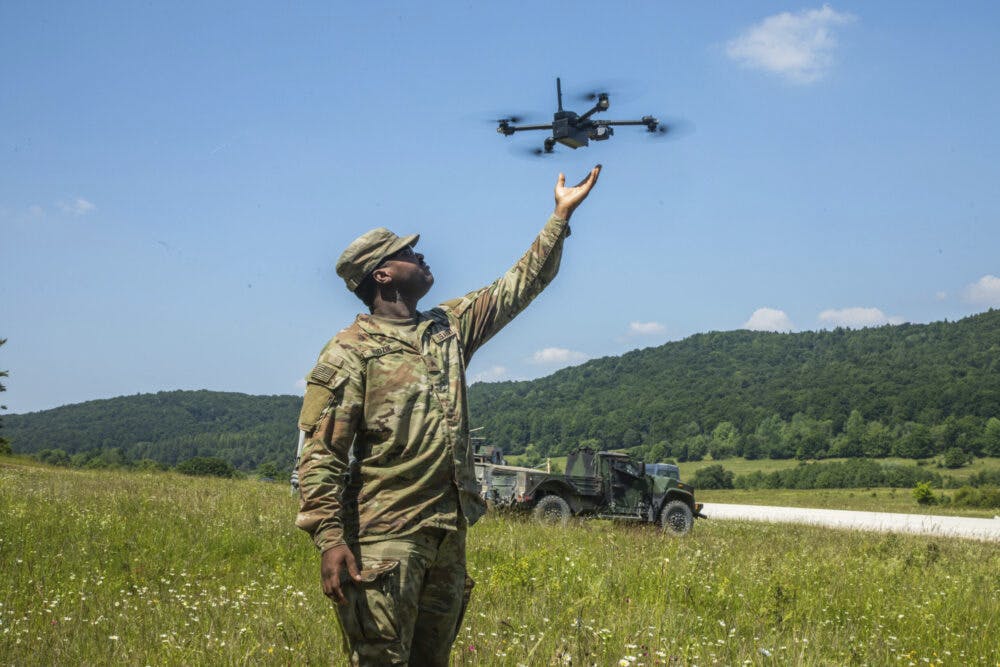
Federal leaders are developing new strategies and investing more resources to develop counter-unmanned aircraft systems (UAS) in response to the growing use of drones on and off the battlefield.
President Donald Trump’s One Big Beautiful Bill allocated more than $2 billion for counter-UAS programs and systems on land and sea after its passage in July 2025. Trump also signed several executive orders in June 2025 to bolster American drone-building capacity and production while expanding counter-UAS capabilities.
“Burdensome red tape has hindered homegrown drone innovation and grounded progress in supersonic flight for generations,” the White House said in a June 2025 statement. “Today’s executive orders accelerate domestic drone innovation, secure supply chains, reduce reliance on adversarial nations, repeal regulations that stalled supersonic flight, and assert U.S. leadership in emerging aviation sectors.”
White House Office of Science and Technology Policy Director Michael Kratsios added that “decades of regulatory gridlock have grounded advancements in drones, flying cars and supersonic flight in the U.S.,” but that the executive orders and shift in strategy around unmanned aircraft systems would “unleash a new era of American aviation dominance, fostering innovation, driving economic growth and protecting our national security.”
Lessons learned from the Russo-Ukrainian war have highlighted the scale of the problem, as both sides have used drone attacks to overwhelm the enemy and strike deep within opposition territory.
Brendan Gavin, general counsel of the U.S. Senate Armed Services Committee, said at the 2025 Global Aerospace Summit in Washington, D.C., last month that growing range and payload capacity have created a “very complex threat environment” the U.S. must defend against.
“It’s one thing to try to employ a counter-UAS system when you have a discrete amount of time, in a discrete place, like a large sporting event like the Super Bowl, and it’s quite another when you have persistent potential threats,” Gavin said.
While large-scale events are becoming proving grounds for counter-UAS measures, defense leaders face additional challenges when it comes to defending against drones on the battlefield.
Gavin pointed out that the economics of deterring drone attacks mean that millions of dollars can be spent shooting missiles at drones that cost only thousands to make, which he said is “not sustainable.”
“We don’t have the magazine depth. We don’t have the defense industrial base producing the kind of munitions to keep up with that. We need to be thinking from a capabilities perspective about bringing in all of the technology that we can. The government is not going to be able to take the lead on the technology aspect of this,” Gavin said.
Military commanders are examining the threat posed by small UAS, whose low production costs and small size pose a major threat when paired with the capabilities of artificial intelligence.
Col. Neal Lape, military deputy director of Fires at the Office of the Deputy Chief of Staff, G-3/5/7, U.S. Army, said “the small UAS threat is growing exponentially” at the 2025 AUSA convention in Washington, D.C. last week.
“It’s no longer just about short-range tactical weapons; overall increases in range and endurance tied with autonomy and artificial intelligence have produced tactical, even strategic results over the last year. Attacks are becoming increasingly complex, with small UAS used in coordinated attacks with cruise missiles and tactical ballistic missiles,” which he said make life very difficult for defenders.
Commanders emphasized the importance of developing more UAS and counter-UAS capabilities at scale and building them domestically to counteract this growing challenge.
“We’ve now seen a big shift coming back to the homeland. We’re looking for capability that can be used in a kinetic sense, in the theater of combat, or maybe having the low-collateral type capabilities that you would use at home. Each one of the services is looking at how they might approach that problem set, and then there is collaboration along the way,” Maj. Gen. David Stewart, director of the Joint Counter-Small UAS Office and director of Fires in the Office of the Deputy Chief of Staff, G-3/5/7, U.S. Army, said during the AUSA conference.


This is a carousel with manually rotating slides. Use Next and Previous buttons to navigate or jump to a slide with the slide dots
-

VA CDO Wants Data to be as Reliable as Water, Electricity
Lisa Rosenmerkel said the agency is striving to utilize its data with utility-level reliability to make it easier to get services to veterans.
3m read -

Lawmakers Weigh Frontier AI Safety Next Steps From Joint Accord
Some tech stakeholders said limiting unintended consequences of AI agents means the industry’s incentive structure has to change.
-

HHS Looks to Centralize IT Buying, Speed Access to Emerging Tech
HHS is centralizing IT procurement while pursuing faster acquisition tools for AI and other emerging technologies.
9m watch -

Intel Chief Jay Clayton Heads ‘Super Intelligence Force’ as AI Czar
President Donald Trump names DNI Jay Clayton White House AI czar to lead a new Super Intelligence Force coordinating federal AI efforts.
3m read


